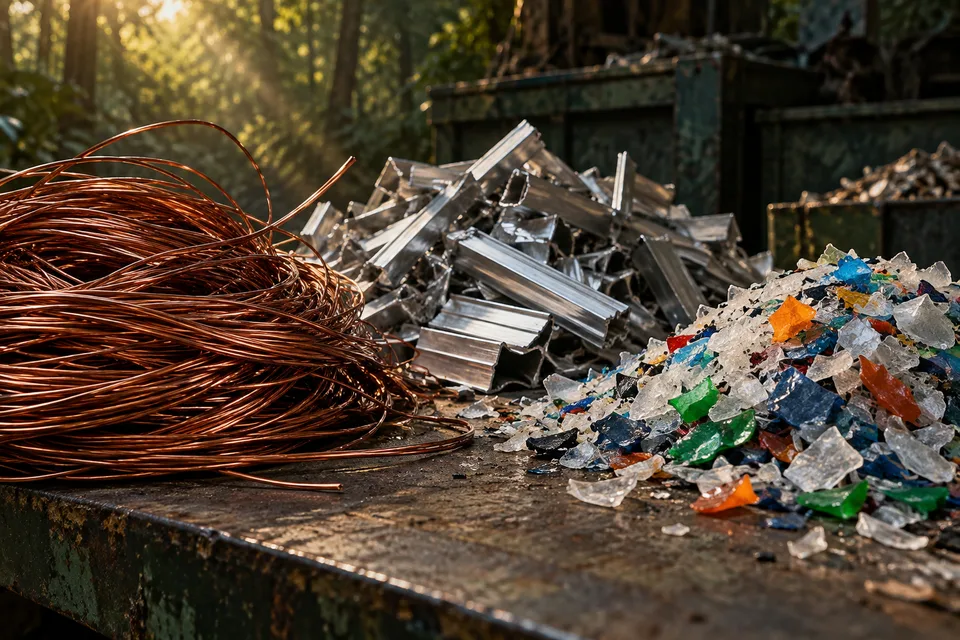
At the collection point, recycling looks like a completed act. A package leaves the household in the correct container; a truck takes it away. The resident has done something useful. The material has only begun a second, less visible journey.
It must be identified, separated from things that do not belong, processed into a usable feedstock and accepted for another product. Each handoff can change the quantity, quality and eventual purpose of what remains. The recycling rate printed beside the collection scheme may describe one point along that journey. Without knowing which point, the number is difficult to judge.
The issue is becoming more consequential as policy moves beyond asking people to sort waste. The European Commission says the EU’s Packaging and Packaging Waste Regulation began phased application on 12 August 2026, with important later requirements on recycled content and recyclability. The general application date does not mean every later obligation began simultaneously. The direction is nevertheless clear: the next product belongs in the policy conversation, alongside the discarded one.
The first journey ends in a bale
Think of a clear PET beverage bottle entering a collection system. Its material, color and design can influence the route available to it. So can the way it is collected and the other items arriving with it. The word “plastic” is too broad to describe this journey: a stream of similar bottles presents a different processing task from a mixture of unlike materials and formats.
Collection creates an opportunity for recovery. It does not guarantee that every collected item is accepted by the next process. A sorting facility needs to produce streams that meet downstream needs. Rejects and contamination do not disappear because the incoming load was recorded under a recycling service.
This distinction is visible in the OECD’s 2022 Global Plastics Outlook. Its estimate that 9% of plastic waste was ultimately recycled refers to the global picture in 2019, after recycling losses. It is neither a measurement of every present-day local scheme nor a universal rate for PET bottles. Repeating the percentage without its year and boundary removes most of what makes the statistic meaningful.
For a municipality, the corresponding local question is straightforward but demanding: what happened after collection? The answer needs records from the chain, not just a weighbridge total at the beginning. A contractor can operate an efficient collection route while the material’s later destination remains poorly documented. Those are separate aspects of performance.
The public does not need to become a polymer laboratory to understand this. It needs instructions that match the actual local system and reporting that distinguishes collection from subsequent recovery. Asking residents to follow detailed rules while publishing only a vague destination weakens the relationship on which the service depends.
An invented hundred tonnes
Consider a deliberately simplified example. A scheme collects 100 tonnes of a target stream. After sorting and preparation, 80 tonnes remain suitable for its chosen recycling route. Processing yields 60 tonnes of secondary material. The rest has left that particular useful-material flow at one stage or another.
These are invented numbers for explaining boundaries, not an estimate of a real plant or a typical recycling yield. They produce three different statements: 100 tonnes collected, 80 tonnes accepted into a process and 60 tonnes of secondary output. All can be correct at once. Describing any one as “the amount recycled” without explanation invites confusion.
Now suppose the 60 tonnes enters an application where it replaces 54 tonnes of primary material under the assumptions of the comparison. That adds another result: substitution. It is not necessarily identical to secondary output. A different application or formulation could produce a different relationship, which would need evidence rather than a default ratio.
| Point in the illustrative chain | Quantity | What the number establishes |
|---|---|---|
| Collected | 100 tonnes | Material captured by the scheme |
| Accepted after preparation | 80 tonnes | Feedstock available for the selected route |
| Secondary output | 60 tonnes | Material produced by reprocessing |
| Assumed primary-material displacement | 54 tonnes | Substitution within this invented comparison |
The arithmetic does not say which boundary a particular official target should use. Those definitions belong to the relevant system. It shows why a before-and-after comparison must use compatible measures. A city cannot demonstrate an improvement simply by moving its reporting point upstream, where the weight is larger.
It also helps locate a real improvement. Better capture could increase incoming material. Cleaner collection could improve the usable share. A different process could preserve more functionality. A dependable buyer could make use of output that otherwise lacks a destination. Calling all these changes “more recycling” can conceal which one actually happened.
The manufacturer asks a different question
The sorting system asks where the material belongs. A manufacturer asks whether it can make a consistent product from it. That requires more than knowing the material has previously been used. Composition, contamination and processing history affect how a feedstock behaves.
A 2024 Nature Communications study of high-density polyethylene makes the material history less abstract. In its experiments, initial degradation was dominated by chain scission: long polymer molecules breaking into shorter ones. Increasing oxygen exposure shifted the dominant behavior toward long-chain branching. The material could still be called HDPE while its molecular structure and processing behavior changed.
The researchers used rheology—the study of deformation and flow—to simulate degradation and relate it to extrusion experiments, then extended the approach to post-consumer recyclate. A manufacturer cares because a melt that flows differently may need a different process or fail to deliver the required product properties. The study offers a characterization method for its investigated materials; it does not turn a polymer name or a single reading into universal evidence of suitability.
The work points to a practical problem with the phrase “good enough for recycling.” Good enough for which product? A material’s useful properties are judged against an intended function. A manufacturer needs an appropriate specification and a way to know whether incoming batches meet it. The end use cannot be added as an optimistic footnote after a process has been installed.
Consistency has economic value. If a buyer must redesign a process whenever the feedstock changes, a nominally inexpensive material can become costly to use. Conversely, better characterization and predictable supply can make secondary material more usable without requiring a claim that it is indistinguishable from every virgin grade.
This is why counting installed recycling capacity is incomplete. A line capable of processing material needs suitable input, operating conditions and a market for the output. Nameplate throughput is not a record of actual production. Actual production is not a record of a useful final application. Each step deserves its own evidence.
The designer of the original package participates in this chain too. A combination that performs well on a store shelf may create a separation problem later. The right response is to investigate the entire package and its likely route, rather than assume a small recycling symbol repairs incompatible design choices. End-of-life performance begins before the first purchase.
The bottle’s second life is not the last question
The European Environment Agency’s briefing on recycling quality broadens the discussion from volumes to preserved function and useful material loops. In its PET-bottle case study, a deposit-refund route returning material to bottles performs strongly. The briefing also emphasizes that the best pathway can differ across material and product streams. A result for one bottle system is not a universal rule that every item must return to an identical product.
The EEA result also has an explicit scoring design. Its method gives 30% weight to pathway efficiency, 30% to potential for further material loops and 40% to environmental impact, approximated through carbon-footprint evidence. It does not include costs in the quality assessment. Those choices make the comparison inspectable; the result is not an unweighted law declaring one pathway best under every objective.
Returning material to the same product type can preserve value while still involving losses and energy demand. Sending it to another product can be useful while making the next recovery harder. A buyer comparing cost, and a public body comparing carbon and future recovery, may legitimately need different decision criteria.
The next product should therefore be visible in an environmental claim. Does the material replace a primary input? Does the new design remain recoverable in an available system? Is the material being put into a durable useful application, or merely moved to a less visible disposal problem? The answer depends on the particular route, not the appeal of calling it a second life.
Life-cycle comparisons add another layer. Transport, processing, energy and the material displaced all affect environmental results. A larger mass recovered does not by itself establish the better outcome under every impact measure. A credible comparison states its functional purpose and assumptions, including how benefits are assigned between products and lifecycles.
It should also distinguish a technical possibility from a functioning market. A laboratory demonstration may show that a material can be transformed. That does not establish a dependable commercial route for all collected items. The demonstration is evidence of potential; operating data, specifications and buyers are evidence of a system using it.
The rate that rises for the wrong reason
A percentage has a numerator and a denominator. Suppose a reported recycling share rises while total material use grows faster. The share may indicate an improvement in the handling of waste, yet the absolute demand for new material can still increase. A circular-economy claim needs to explain both trends.
The reverse can be revealing too. If a prevention measure reduces disposable packaging, a collection service might receive fewer tonnes. That is not automatically a deterioration in environmental performance. Rewarding a system only for tonnage can create a strange incentive to preserve the waste stream it exists to manage.
An informative public report could therefore show waste generated, material collected, useful secondary output and destinations, where reliable data exist. It could identify the data gaps rather than collapse everything into one confident total. The result would be more complicated than a single rising line, but much easier to connect to decisions.
For businesses, the same principle applies to recycled-content claims. A product containing secondary material is a specific achievement. It does not establish how the product will be collected later or the total reduction in primary-resource use across a growing business. Those claims need separate support. One good characteristic should not become a proxy for every environmental question about the product.
The reporting burden should be proportionate, but it should follow the material far enough to support what is being promised. Where the final destination is unknown, the claim should stop at the known boundary. Making the uncertainty visible is more useful than decorating it with a circular arrow.
One practical question cuts across these measures: can the records distinguish a sale from a final use? A shipment to a broker or another processing facility is a handoff, not necessarily the end of the chain. That does not make the shipment suspect. It means the evidence needed for a claim about a finished product lies farther downstream. Contracts and data-sharing arrangements should reflect how far the public claim intends to reach.
The same record should retain what happened to rejected material. Excluding it from a useful-output calculation is appropriate; making it vanish from the account of the system is not. A process can improve its main product while producing residuals that still require responsible management. An honest material balance leaves space for both.
The resident at the collection point still has an important role. Correct sorting can help make a useful stream possible. The rest of the chain has to honor that effort: a design that can be separated, a process that preserves value and a new product that actually uses the result. Recycling succeeds beyond the moment when the package disappears from view.
Sources & context
This article draws on the sources linked in the text. Analysis and illustrative scenarios are identified separately from reported findings.
- Packaging and Packaging Waste Regulation began phased application on 12 August 2026
- 2022 Global Plastics Outlook
- 2024 Nature Communications study of high-density polyethylene
- European Environment Agency's briefing on recycling quality