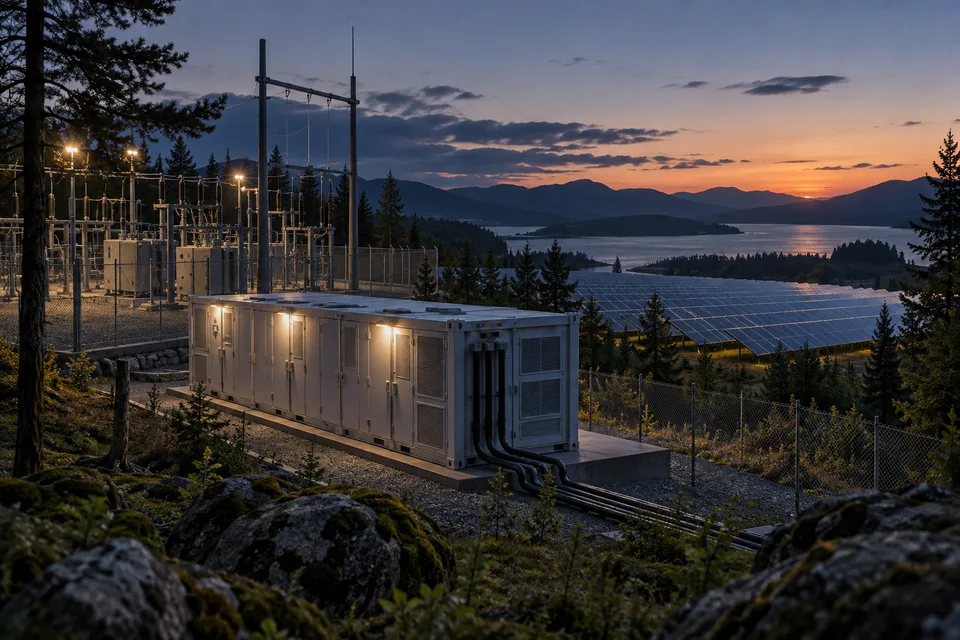
A fictional battery project has two numbers on its specification sheet: 100 megawatts of discharge power and 400 megawatt-hours of usable discharge energy. Dividing the second by the first produces four hours. That arithmetic is straightforward. Almost every interesting question about the project’s value comes afterwards.
Four hours at what output, under which conditions, starting with how much charge and serving which need? The duration does not answer those questions on its own. Nor does it make the project either a complete replacement for every other resource or an inherently inadequate technology. A tool can be useful within a defined job without solving the whole power system.
The distinction is increasingly important as batteries become a familiar part of electricity planning. The IEA’s Electricity 2026 flexibility chapter describes their roles in balancing, shifting energy and contributing to supply security. It also cautions that aggregate nameplate capacity can differ from actual discharge during a peak event. The useful evaluation begins with the service, rather than treating installed megawatts as a finished reliability result.
First, keep the two numbers separate
Power is the rate at which the battery can deliver energy under specified conditions. Energy capacity concerns the quantity available over time. The US Energy Information Administration’s explanation of battery characteristics defines nameplate duration as the ratio of energy capacity to power capacity. That 2018 explainer remains useful for the definition; its market examples and duration categories belong to its historical context.
In the fictional project, a lower discharge rate could extend the period of delivery in a simplified model. Delivering 50 MW for eight hours also totals 400 MWh. That does not turn the equipment into a source capable of delivering 100 MW for eight hours. Extending time by reducing power changes the service being supplied.
Actual delivery needs more detail than this idealized calculation. Usable operating limits, conversion losses, equipment condition and the charge available when the event begins can affect the result. A project specification should explain which boundary each number represents. Comparing stored energy inside one system with delivered AC energy from another can otherwise create an apparent advantage that comes from inconsistent accounting.
Charging needs a schedule too. Assume, only for illustration, 80% round-trip efficiency measured from AC charging input to AC discharge output. Delivering 400 MWh then requires 500 MWh of charging electricity. At a constant 50 MW input, that takes ten hours, not the four hours on the discharge nameplate. This does not assign an efficiency to an actual project. It exposes why a short cheap charging window, the charging-power limit and the required next discharge must fit one another.
These questions are distinct from the chemistry. A particular chemistry influences technical and commercial choices, but knowing its name does not reveal the whole installation’s available power or duty cycle. Controls, inverters and the operating agreement can all affect how the system is used. The nameplate is the start of an engineering description, not its conclusion.
Job one: respond quickly without emptying the store
Some power-system services require a rapid response over comparatively short intervals. The relevant capability can involve how quickly and accurately a resource follows a signal, alongside the energy and operating headroom needed to continue providing that service. A long nominal discharge duration is not the only characteristic that matters.
For this kind of job, the battery’s power capability and controls can be central. It may need room both to increase and reduce its output, depending on the service design. A fully charged or depleted state can limit what it can do next. The operating strategy therefore needs to manage state of charge, rather than assume every stored unit is always available for every possible use.
The system must also meet the specific requirements of the service and market in which it participates. A rapid response seen during a demonstration does not establish that the installation has satisfied those requirements. Qualification, monitoring and dispatch arrangements belong to the actual application. There is no universal inference from fast electronics to a complete grid-service offer.
This is why duration alone can be a poor comparison between projects serving different jobs. An installation with a shorter store may be well suited to one defined response duty, while a longer-duration installation may be designed to move substantial energy between periods. Asking which is better without naming the job removes the criterion that would make the comparison meaningful.
Job two: carry energy from one part of the day to another
Now the fictional battery is assigned an evening energy-shifting task. It charges during an earlier period and discharges during a later one. Here the length and shape of the required delivery become particularly important. A short, high peak and a broad, lower peak can require different combinations of power and energy.
Consider two expressly illustrative schedules. One requires 100 MW for four hours. The other requires 100 MW for six hours. In the idealized arithmetic, they need 400 MWh and 600 MWh respectively. The same 400 MWh store cannot supply the second schedule at the stated power merely because its first four hours are useful. It can still contribute part of the requirement within a larger system.
The time when the peak occurs can shift as the generation and demand mix changes. Storage itself can reshape the remaining peak by supplying its narrowest portion. A planning method needs to account for the resulting system, rather than assign a permanent reliability value to a duration label regardless of what else has been built.
EIA’s April 2026 Electricity Market Module assumptions describe a submodule developed to represent the value of four-hour battery storage in the modeled system. That is a statement about an analytical framework. It should not be read as proof that every installed battery has four hours of duration or that the model represents every operational detail of every project.
A charge-discharge plan can also face local network limits. The cheapest available energy in a wider market may not be deliverable to the battery at the desired rate. The battery’s discharge can be constrained by its connection or by conditions elsewhere on the network. Location therefore remains part of the service, even for equipment whose underlying technology is widely available.
Job three: remain useful through a longer shortage
A prolonged period of low available supply asks a different question from an evening peak. The system may need energy over many hours or days, with limited opportunities to recharge. Adding power without enough stored energy cannot resolve the whole duration requirement. Adding energy without the needed discharge capability cannot resolve the whole power requirement either.
The US Department of Energy’s long-duration storage program defines its scope as systems capable of delivering electricity for ten or more hours. That is a program definition, not a natural boundary at which one technology suddenly becomes useful and another ceases to matter. A report should identify whose definition it uses when comparing categories.
Longer duration can be valuable where the system needs it, but it does not eliminate other questions. What is the charging source? How often is the long event expected? What happens if several difficult periods arrive close together? An energy store that begins an event partly empty offers a different service from one assumed full at the start of a model run.
Other resources can complement storage: different generation profiles, connections to other regions, demand flexibility or other forms of energy storage, depending on the setting. The planning objective is a workable portfolio under relevant conditions. It is not to find one equipment label that can be credited with every desirable property at once.
The same capacity cannot always do everything simultaneously
A project may participate in more than one service. That can improve its usefulness and commercial prospects. The combination still needs an operating account. Energy committed to an earlier duty may be unavailable for a later one, and keeping reserve headroom can limit energy sold elsewhere. Summing the maximum possible contribution to each service can overstate what the same installation can actually deliver.
In an idealized power-only example, scheduling 100 MW from equipment limited to 100 MW leaves no additional 20 MW of upward reserve. Scheduling 80 MW leaves that headroom, subject to the remaining energy, response capability and market requirements. Reserving power and reserving stored energy are separate choices. An operating plan needs to state how both are protected when an evening forecast and a different service request compete for the same installation.
This distinction also matters for public claims about backup. A grid-connected battery installation is not automatically an independent backup system for nearby buildings. The necessary electrical arrangement, controls and permitted mode of operation have to be designed for that service. Physical proximity does not establish a protected supply path during an outage.
Degradation adds a time dimension to the nameplate. Available capability can change over the project’s life, depending on use and design. A long-term commitment may involve augmentation, replacement or operating limits. Those assumptions should be attached to the promised service, rather than leaving readers to infer that a launch specification persists unchanged for decades.
Price the job rather than the slogan
An energy-shifting business case depends on the relationship between charging and discharge periods, efficiency, utilization and other project costs. Take invented prices of $40 per MWh to charge and $70 per MWh for discharge. Under the illustrative 80% round-trip assumption, buying 500 MWh costs $20,000 and selling 400 MWh earns $28,000: an $8,000 gross spread before other costs. Applying the price difference to 400 MWh would instead suggest $12,000 and omit the lost energy. These are teaching prices, not a market quotation or investment forecast. Fees, degradation, capital recovery and the frequency of workable cycles still have to fit inside the actual business case.
A per-kilowatt figure and a per-kilowatt-hour figure answer different cost questions. One relates cost to power capability; the other relates it to energy capacity. Comparing the cheapest figure chosen from each project would mix units. A serious comparison uses a consistent scope and examines the service the installation is required to provide.
The same caution applies to a capacity payment or other service revenue. Eligibility and value depend on the relevant rules and the resource’s demonstrated contribution. A commercial projection should not assume every technically imaginable revenue stream is fully available at the same time. An operating constraint can become a financial constraint even when both separate opportunities are real.
There is also a counterfactual. A battery might defer one specific network investment, reduce curtailment or help manage a particular peak. Each benefit needs a comparison with what would otherwise happen. Crediting the same installation with several versions of the same avoided cost can inflate the case, while ignoring a genuine combined benefit can understate it.
What the specification should let a reader ask
Return to the fictional 100 MW, 400 MWh project. A useful description identifies usable delivery at the relevant boundary, starting charge assumptions, the intended schedule and the conditions under which that schedule has been assessed. It should explain the difference between nominal capability and the service being contracted or modeled.
Put the intended duty beside the specification: how much power, for how long, starting at what state of charge, and with what reserve left for the next obligation? The same four-hour installation can look generous for one service and inadequate for another. Its contract and dispatch plan should make that choice legible. For the fictional 100 MW project, 400 MWh is the start of the engineering brief. The power system is buying what the operator can deliver with it.
Sources & context
This article draws on the sources linked in the text. Analysis and illustrative scenarios are identified separately from reported findings.
- IEA's Electricity 2026 flexibility chapter
- US Energy Information Administration's explanation of battery characteristics
- April 2026 Electricity Market Module assumptions
- long-duration storage program